
Close

A very quiet classroom may look impressive, but it can sometimes give the wrong impression. When parents visit a school, they may see young children sitting quietly behind desks. At first glance, this may seem like good discipline, and many people assume that learning is happening.
However, silence does not always mean learning. Often, it simply means that children are following instructions and trying to stay quiet.
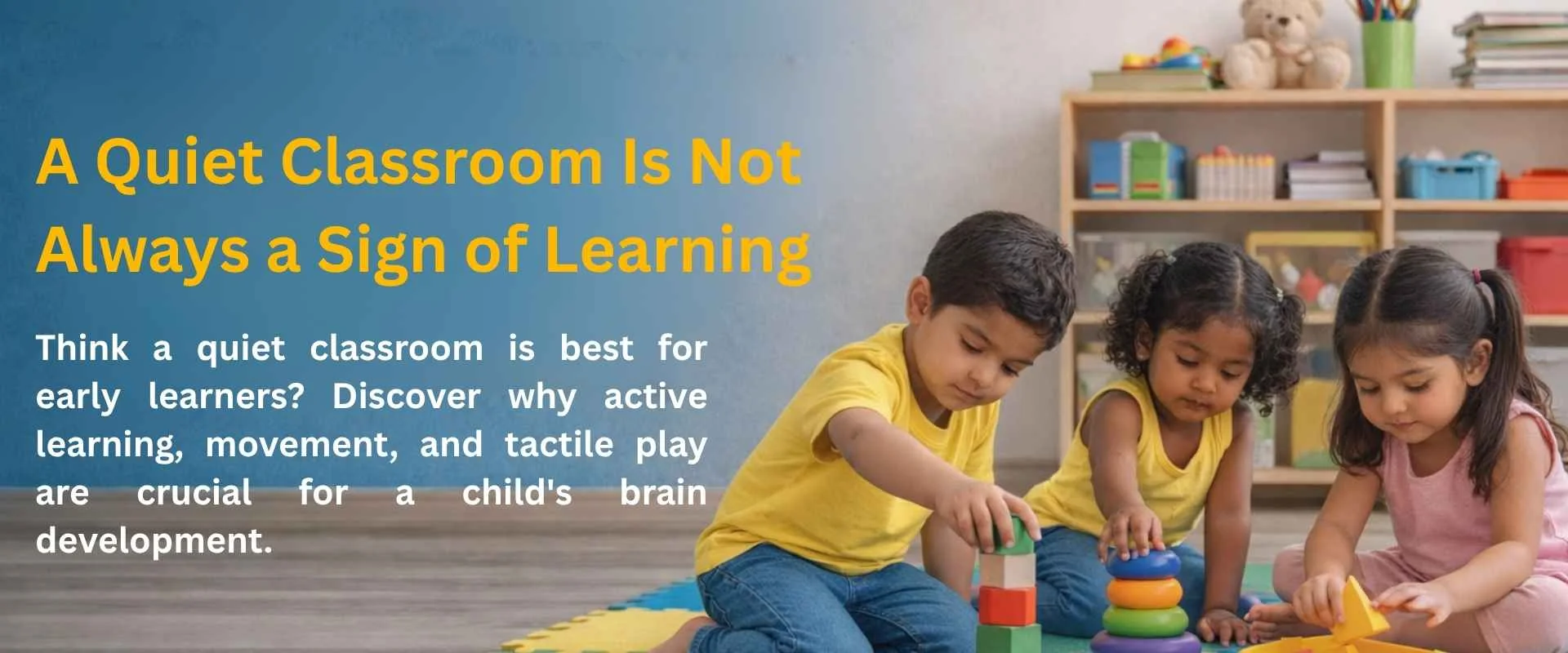
At the pre-primary stage, children learn best through movement, exploration, and hands-on experiences. Their brains develop when they move, touch objects, ask questions, and try new things. For example, when children sort colourful beads, stack blocks, or play with clay, they are not just playing, they are learning important thinking skills.
When children are expected to sit quietly and only listen for long periods, they may miss valuable opportunities to explore and understand the world around them.
Sometimes children appear to be learning simply because they can repeat information. For example, a teacher may show a picture of an apple and the child says “apple.” While this shows recognition, it does not always mean deep understanding.
True learning happens when children experience and explore concepts themselves.
For example, a child may memorize the word “circle,” but understanding shapes becomes clearer when the child handles objects—rolling a ball, tracing a round plate, or fitting a circular block into a matching hole. Through these activities, children learn about shapes, size, and space.
Passive learning makes children repeat information. Active learning encourages them to observe, experiment, and solve small problems, just like little explorers.
For young children, the hands are powerful learning tools. Many important skills develop when children touch, hold, and manipulate objects.
For example:
Every time children touch new materials—sand, clay, wood, paper, or water their brains form new connections. These connections help them develop problem-solving skills, creativity, and confidence.
Hands-on activities also strengthen fine motor skills, which include small hand movements used for writing, drawing, and everyday tasks.
Modern classrooms often include smart boards, tablets, and other digital tools. While technology can support learning, it cannot replace real experiences.
When children swipe a screen, they do not feel weight, texture, or resistance. For example, moving a puzzle piece on a tablet is very different from holding and fitting a wooden puzzle piece with their hands.
Physical materials such as blocks, puzzles, clay, beads, and sorting objects—help children develop stronger hand coordination and deeper understanding.
This is why early childhood classrooms should provide opportunities for children to build, create, explore, and even make a little mess while learning.
The early years of education create the foundation for a child’s future learning. When parents are choosing a CBSE school in Vadodara or selecting a primary school for their child, it is helpful to look beyond desks and screens.
Instead, observe the learning environment and ask questions such as:
Parents may also consider asking the school an important question during the admission process: “How much time during the day are children actively moving, exploring, and learning through activities?”
This helps parents understand whether the school truly supports active learning.
Sometimes a child may return home with clay on their hands, paint on their clothes, or sand in their shoes. While this may look messy, it often means the child has spent the day exploring, experimenting, and learning.
Children who stack blocks, sort objects, pour water, draw pictures, and play with different materials are developing important thinking skills.
On the other hand, a child who sits still all day may not have had the same opportunities to explore and understand.
When children are given the chance to touch, build, create, and discover, they develop curiosity, confidence, and a love for learning that will support them throughout their education.